
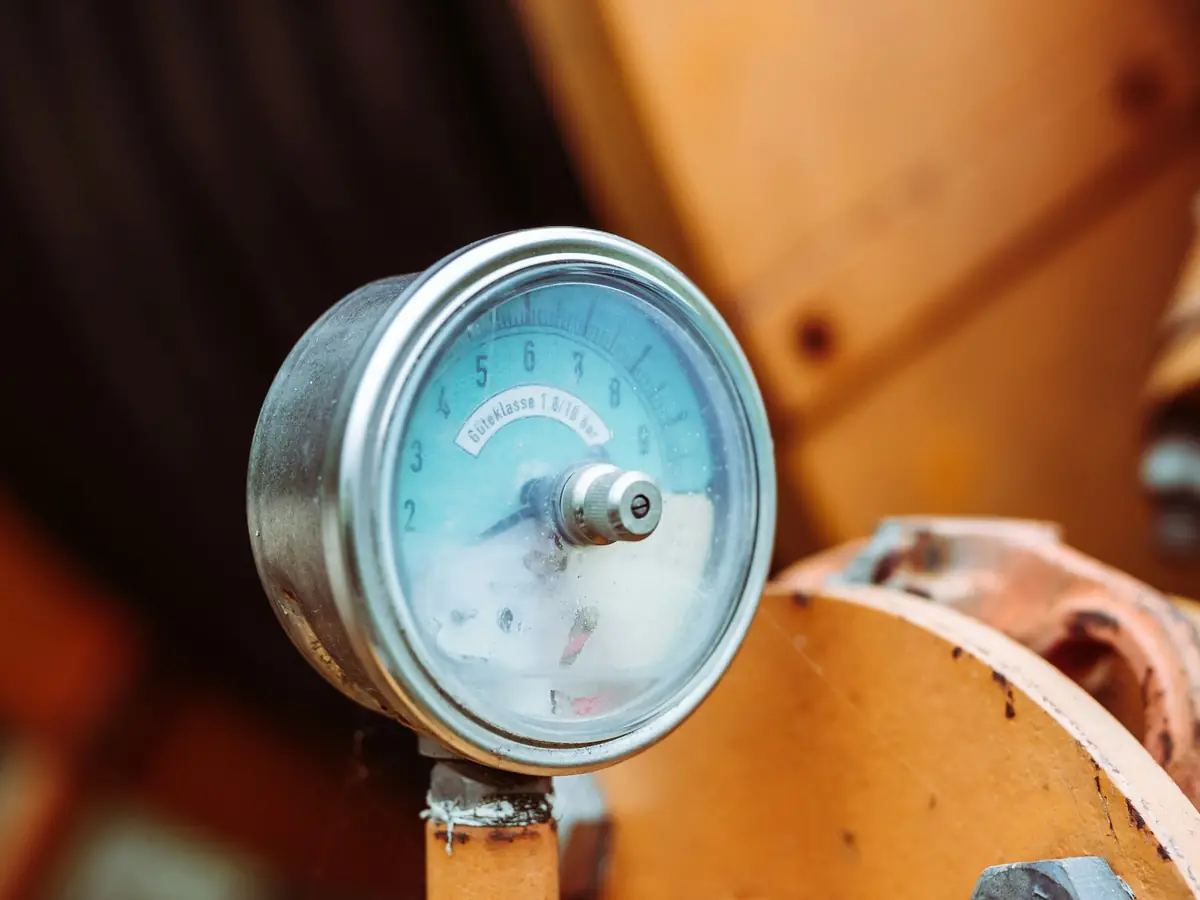
Signs of a water pressure problem
Pressure too low
- Weak flow at every faucet and shower
- Showers that drop off when another fixture runs
- Slow-filling toilets, washers and dishwashers
- Pressure that has slowly gotten worse over years
Pressure too high
- Pipes bang when faucets or the washer shut off
- Water heater relief valve drips or discharges
- Toilets that keep running and faucets that start dripping
- Washing machine hoses or supply lines bursting
- Water blasts out of faucets
Test your water pressure
Screw an inexpensive pressure gauge onto an outdoor spigot, turn the spigot fully open with everything else off, and read it. About 40 to 60 psi is comfortable. Code generally calls for a pressure reducing valve when street pressure exceeds 80 psi.
If the reading is high, the PRV is missing or failing. If the reading is normal at the spigot but flow is weak at fixtures, the problem is inside the house: clogged aerators, a stuck cartridge, narrowed galvanized pipe or a partly closed valve. If the reading is low everywhere, check that the main valve is fully open, then look at the PRV and the service line.
What causes pressure problems
- Failing pressure reducing valve. PRVs typically last around 10 to 15 years. When the internal diaphragm or seat wears, the valve either lets full street pressure through or chokes the flow.
- Galvanized pipe slowly narrowing inside with rust, common in older homes.
- A leak in the service line or house piping drawing off water.
- Partly closed valves, often after recent plumbing work.
- Thermal expansion in a closed system without an expansion tank, which spikes pressure each time the water heater runs.
- Utility-side pressure changes, which the water provider handles.
How pressure problems are fixed
PRV adjustment or replacement
The PRV is usually found where the main water line enters the house: on a basement or crawlspace wall, in the garage, or sometimes in an underground box near the meter. The plumber checks the downstream pressure and adjusts the valve. If it won't hold a steady setting, the valve is replaced and set to around 50 to 60 psi.
Expansion tank
When a PRV is installed, the plumbing becomes a closed system. An expansion tank on the water heater's cold line absorbs the expanding water, which stops the relief valve dripping and protects the heater.
Fixing low pressure inside the house
Clogged aerators and cartridges are cleaned or replaced. Restricted galvanized sections are replaced, and if the whole house is galvanized, repiping is the lasting fix. Leaks are found with leak detection, and a damaged service line is handled with water line repair.
Water hammer arrestors
Arrestors at the washing machine and dishwasher absorb the shock of quick-closing valves and stop banging pipes once pressure is corrected.
Why pressure varies so much between Canton homes
Water systems use elevation to create pressure: water flows from storage tanks and pumps through the mains, and every foot a home sits below the water level adds pressure. Canton sits at about 968 feet but its terrain rises and falls sharply around the Etowah River valley and the surrounding hills. 2 homes a short distance apart can receive very different street pressure depending on how far downhill they sit.
That's why some Canton homes have high pressure and depend on a PRV, while others at the top of a hill run lower. If your house sits low on a slope, check that a PRV is installed and working, because high pressure quietly shortens the life of every fixture, hose and appliance.
Many homes built during Canton's 2000s building boom have PRVs that are now reaching the end of their service life. See our Great Sky page for more on homes from that period.
What affects the cost of water pressure repair
- The cause. Adjusting a PRV or cleaning aerators is quick; replacing galvanized piping is a much bigger job.
- PRV location. A valve in an open basement is easier than one in a buried box at the street.
- Valve size and whether new unions and shutoffs are needed.
- Expansion tank added at the same time.
- Leaks or line damage found during diagnosis.
When a pressure problem is urgent
- You suddenly have no water or only a trickle and neighbors have normal water
- The water heater relief valve is discharging continuously
- A supply hose or line has burst from high pressure
For a burst line, shut off the main and call our emergency plumbing line. Sudden loss of pressure can also mean a broken service line, so check for wet ground between the meter and the house.
After a pressure repair
Recheck the pressure with the gauge a week later to confirm the PRV is holding. Note where the PRV and expansion tank are so you can check them in future. Pressure problems are a common diagnosis for us as a plumber in Canton, GA, and fixing them often prevents the next faucet, toilet or water heater failure.
Water pressure questions
What's normal water pressure for a house?
About 40 to 60 psi is comfortable for most homes. Above 80 psi, a pressure reducing valve is generally required by code and helps protect pipes, fixtures and appliances.
Where is my pressure reducing valve?
Usually just after the main shutoff where the water line enters the house: on a basement or crawlspace wall, in the garage, or in a utility closet. It's a bell-shaped brass valve with an adjusting bolt on top. Some are in a box near the meter.
Why is pressure low in only one faucet?
A clogged aerator or cartridge in that faucet is the usual cause. If it's only the hot side, the problem may be at the water heater or the hot water piping.
Can high water pressure damage my water heater?
Yes. It stresses the tank and makes the relief valve drip, and without an expansion tank, each heating cycle spikes the pressure further.